On my bucket list before leaving Korea was a trip to the DMZ. Since Michael (and literally everyone I know) has already been there, I decided to travel with a tour group from the US Armed Forces USO. It was an amazing jam-packed day filled with everything you would want to know about the Korean War, the DMZ (stands for Demilitarized Zone), and North Korea.
Since Seoul is close to the DMZ it took less than an hour to get to our first stop, The 3rd Tunnel. This is one of a series of four underground tunnels (there might be more but they haven't found them yet) that were built by the North Koreans to smuggle troops into South Korea. It was discovered, along with many more, and turned into a tourist attraction. Something about that seems like a real slap in the face to the North Koreans, don't you think?
We weren't allowed to take photos inside the tunnel, but here is a picture I got from their website.
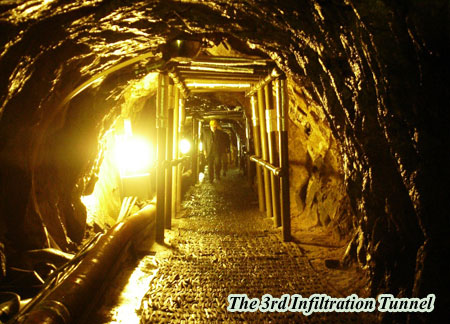 |
| The tunnel was very low because the average size of a North Korean man is about 5'6". I had to bend down the entire length of the tunnel and wear a safety helmet. |
We then traveled to the Dora Observatory for a view of the DMZ and North Korea.
 |
| This was the sign on the observatory, "End of Separation, Beginning of Unification." Sadly it looks like this was painted a long time ago. |
 |
| This is the one commerce road that leads from South Korea to North Korea. We did not see any trucks on this road at all. |
 |
| A view toward "Propaganda City," which is a fake city built by the North Koreans in an attempt to lure South Koreans over the boarder because the North looks so prosperous. Nobody lives in this city and the buildings are just empty shells. They told us that propaganda plays over loud speakers 8 hours a day, but we couldn't hear anything. |
 |
| I loved taking pictures of people taking pictures. There were about 100 people crammed into a tiny space trying to get the perfect shot of North Korea. Usually, you can only take photos from behind a line about 20 feet from the edge of the balcony but that rule wasn't enforced this day. |
We then traveled to a working but not working train station. The train station was built to carry people from the South to the North and vice versa once unification happened, but it now sits empty.
 |
| I'm standing in front of a sign that points toward Pyeongyang (the capitol of North Korea) and Seoul (the capitol of South Korea). |
We then traveled to the JSA (Joint Security Agency) where we were met by US Servicemen who checked our passports and asked if we were planning on defecting today. They then had a sign a liability waiver that was very extensive.
After signing and watching a movie about what happens at the JSA, we were bussed to the North Korean line to view the buildings that are used by both sides (including the UN member nations) in negotiations.
 |
| The North is behind me. We could take pictures toward North Korea but not back toward South Korea at this point in the tour. |
 |
| The large concrete building in the back is a North Korean building. The two blue buildings are UN buildings where possible negotiations can occur. There are three soldiers standing guard, looking toward North Korea. They were there for our protection but also to guard against aggression or to protect defectors. The soldier in the lower left hand side of the photo was our tour guide, Sergent Bazzle. |
 |
| We had a chance to enter the main negotiation room, which is split down the middle between South and North Korea. This soldier was standing right in the middle of the demarcation line. He holds that stance while he is on duty. The arms, fists, and sunglasses are supposed to appear intimidating to North Korean guards. |
 |
| This was the other South Korean guard in the room. He is actually standing on the North Korean side with the door to North Korea behind him to guard against defectors. Seriously, though, who would want to defect TO North Korea? |
We then drove around the compound for another view of Propaganda City.
 |
| The flag pole in the center of the picture with the North Korean flag is slightly taller than the flag pole with the South Korean flag. No matter how tall the South Koreans build their flag pole, the North Koreans keep building theirs just a little taller. Our tour guide said they also have a huge flag that weighs 600 pounds, and it's so heavy that you can rarely actually see it waving. |


